The Camera I Put Down, and the One I Can No Longer Hold
What fifteen years behind a lens taught me about the quiet extinction of craft in the age of AI.
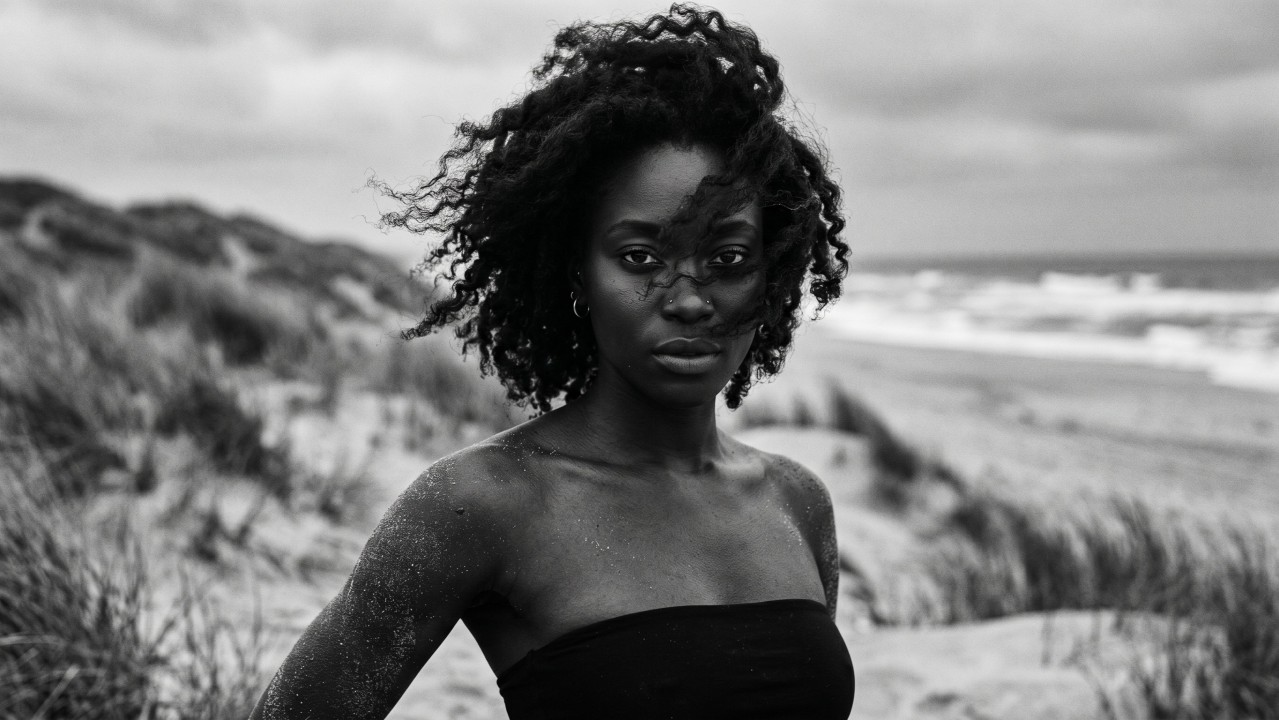
I was a photographer for fifteen years before I moved into innovation and finance.
I knew the weight of a Nikon or Canon in my hand before I knew the weight of a P&L and a governance policy. I knew how to wait three hours for a cloud to move, how to read a stranger’s face well enough to earn one honest frame, how to coax skin tones out of a raw file at 8am after a shoot in the morning with a double espresso going cold beside me when I started to retouch. I used to know the smell of a darkroom before we went digital. I knew that a good portrait is ninety percent listening and understanding and ten percent shutter.
I don’t do that work anymore, except listening and solving problems in a different way. Life moved me into finance, innovation, into product, product design, into building things for people who have never had a bank account. I made peace with putting the camera down.
But I did a small experiment today.
A small experiment
Before you read on, look at the three images below.
A woman on a windswept dune. A couple holding each other with the sea behind them. A woman holding up a handwritten sign. Look closely. The grain. The catchlights in the eyes. The way the hair moves. The salt on her shoulder.
Tell me: are these photographs, or are they not?
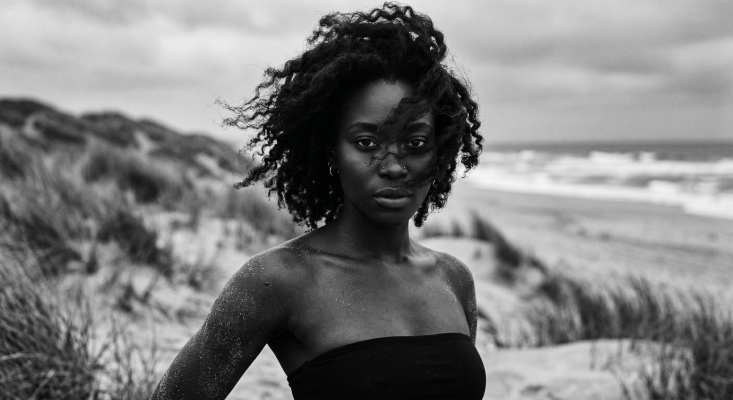
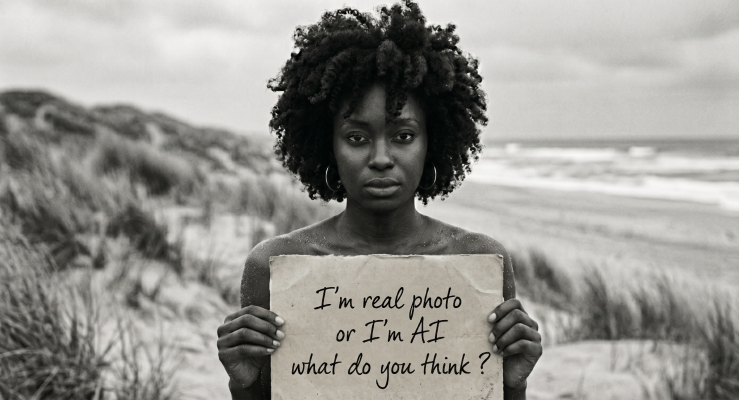
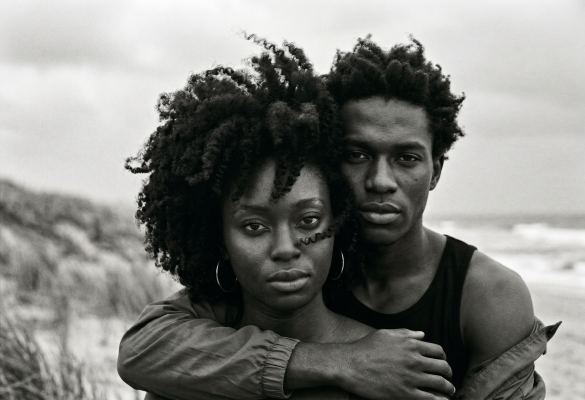
I made all three of them. I did not travel. I did not hire a model. I did not set up a light. I did not wait for the weather. I wrote a few sentences, and a machine gave me what would have cost me, fifteen years ago, a plane ticket, a week of scouting, a crew, and every ounce of craft I had spent my twenties acquiring.
The third image tells you the punchline. But the first two, I assume or hope, fooled most of you for a short moment. That moment is the point.
What is actually being lost
I am not writing this to be nostalgic. I am writing this because I know what it feels like to have spent a decade getting good at something, and I can see, clearly, that the decade is now optional.
The editorial photographer who learned to light a face like Peter Lindbergh (one of my favourite photographers, RIP) did. The stock shooter who built a library one frame at a time. The wedding specialist, the product shooter, the fashion assistant carrying reflectors in Milan hoping for a break. These are not abstractions to me. These are the people I partied with in the 90s and 2000s at the end of long shoots. Many of them will not have a career in some years to come, and the ones who survive will not be paid what the work used to be worth.
This is not unique to photography. I’m watching the same pattern in copywriting, in translation, in first-draft legal work, in entry-level analysis, in customer support, in parts of software engineering. Agents are coming for the middle of the curve, the competent-but-not-singular work, and they are coming fast. They will be cheaper. They will not sleep. They will not ask for benefits. A company that refuses to use them will be outpriced by one that does.
The uncomfortable truth, for anyone who built an identity around a craft, is this: the market does not owe your skill a living just because it took you years to acquire.
What is being created
And yet. I made those three images in an afternoon. A version of me that never owned a camera could have made them too. That is extraordinary, and I do not want to let the grief of the old world blind me to the wonder of the new one.
For the first time, a kid in Lagos, or a domestic worker in Dubai, or a retiree in a small town who always wanted to tell a visual story, can make one. Not a bad one. A good one which resonates with their community. The cost of imagination has not collapsed, it has enabled the dreamers. The distance between “I have an idea” and “here it is, finished, in the world” has become almost nothing.
The question is no longer can I make it. The question is is it worth making, or do I solve a problem which exists.
That question has always been the real one. We just used to hide from it behind the difficulty of the craft.
What to do about it
I think often about people whose livelihoods are even more exposed to this shift than mine ever was. The advice I would give them is the same advice I give myself:
Do not compete with the machine on the machine’s terms. If your value is doing competent, repeatable work, that value is evaporating whether you like it or not.
Learn the tools faster than the people around you. The people who will eat in 2030 are the ones who are, today, directing AI the way they used to direct models and agents.
Go upstream. Taste, judgment, relationships, trust, narrative, the ability to decide what is worth making, these are not being automated. They are becoming more valuable, not less.
Accept the grief. Something real is ending. You are allowed to be sad about it. Then get up, grow up, and learn from it.
Be the human in control, not the human being controlled.
I still have my cameras in a drawer. I pick them up sometimes. They feel heavier than they used to, or maybe I have just gotten older. But I am not putting them down because I have to. I am putting them down because a new instrument has been handed to me, and the people who learn to play it with craft, creativity, and taste, with something to actually say, will make work that the old tools could not have made.
The rest will be made by agents, faster and cheaper, and no one will miss the difference within a few years.
Which one do you want to be?
I spent fifteen years as a photographer before moving into finance and product innovation. Sometimes I’m not sure which was harder. Everything in this article is my personal viewpoint.
Originally published on LinkedIn Pulse.